School cafeteria coordination app for families, staff, and kitchens
Casa Intur, by Nealis Tech, is an Android management app for school cafeterias that centralizes meal service coordination in educational settings. It connects families, teachers, supervisors, and kitchen staff to coordinate daily dining tasks and safety. The app supports multilingual interfaces and secure sign-in methods for different user roles. It is aimed at parents, educators, and kitchen teams who need clearer day-to-day communication and transparent meal records in school dining operations.
Manages menus and kitchen production with photo-backed nutritional detail
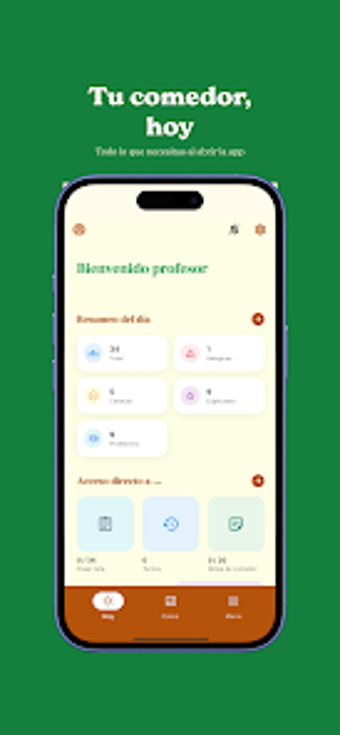
The app publishes daily and weekly menus that include high-quality photos and detailed nutritional data, which parents can consult before a meal service. On the kitchen side, a dashboard provides diner forecasting and shift adaptation to match demand, so production planning and menu visibility operate from the same dataset. High-transparency menu viewing helps link what families see to what the kitchen plans.
Handles daily reporting, attendance, and incident messages between users
Families can report absences or late arrivals directly through the app before a center-set deadline, and staff receive those notices in real time. Teachers and supervisors can take attendance from mobile devices and manage dining shifts and tables, while a built-in channel lets users report incidents or special dietary requests. Push notifications keep recipients informed of important announcements and daily service updates.
Provides multilingual access and device-level security for sensitive data
The app offers interfaces in Spanish, Catalan, and Galician to suit regional school communities, and it runs on Android devices with compatibility updated for Android 14.0 and higher. For security, the system uses encrypted data transmission and supports biometric authentication such as fingerprint or facial recognition, so profiles and student health information remain tied to authenticated accounts.
Fits routine school workflows but focuses on institutional deployment
In everyday use the app maps to common school rhythms: parents checking menus and allergens before drop-off, teachers marking attendance at mealtimes, and kitchens adjusting production to same-day reports. Its role in those routines assumes the center integrates the service and staff adopt the mobile workflows, making the tool practical where the catering ecosystem is already in place.
To sum up, the app suits school communities that need coordinated meal-day operations
To sum up, the app is a practical option for parents, educators, and kitchen staff who want centralized daily coordination and clearer meal records. A notable limitation is that access is restricted to educational centers contracted with the catering provider, requiring registration codes from the school. For enrolled communities the app integrates routine checks and communication into the school day; for external users access is not available.